
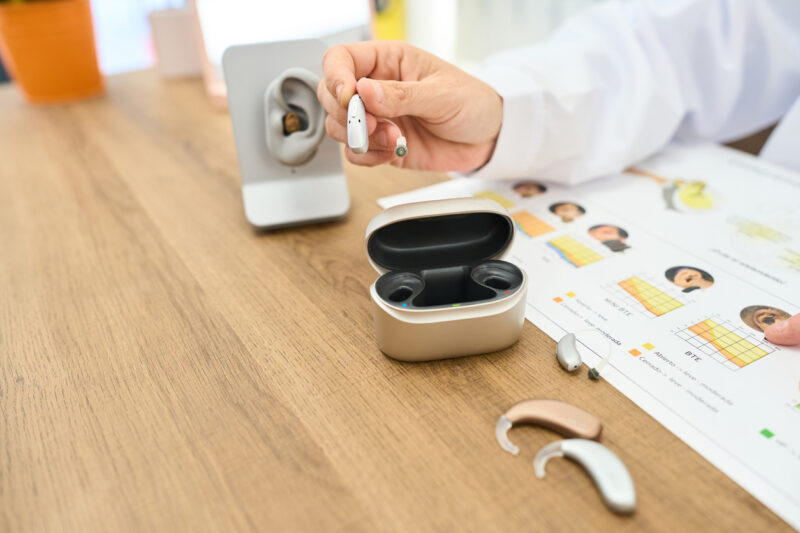
Many people still think of hearing aids as something big and beige tucked behind someone’s ear. And while technology in this respect has advanced by leaps and bounds over the past few decades, the perception has been slower to adapt. Today’s hearing aids are smaller and smarter than most people might expect.
So let’s start with what’s actually changed.
From Ear Trumpets to Digital Processing
Hearing devices go back further than most people realize. Ear trumpets were the standard for centuries. Literally just a cone-shaped device that collected sound and aimed it at the ear canal. No electronics, no batteries, no processing of any kind. Louder was the whole goal, and even that was incredibly limited.
Electric amplification started showing up in the late 1800s. Those early devices worked, more or less, but they weren’t subtle. Big, external, obvious. Transistors made things smaller in the ensuing decades, and by the 1990s digital processing had arrived in consumer hearing aids. That changed the fundamental nature of what these devices could do. Before digital, a hearing aid made sound louder. After digital, it could actually work with sound, shape it, filter it, and respond to different acoustic environments dynamically.
The mechanics underneath are still the same three steps. The microphone picks up sound. The amplifier strengthens it. The speaker delivers it. What’s evolved has been everything that happens between those steps.
What Modern Hearing Aids Actually Do Differently
Background noise is probably the clearest example of real-world improvement. Older devices amplified whatever was in the room, which worked fine in quiet environments but became a problem everywhere else. A busy restaurant, a crowded waiting room, any situation with competing sounds. Current hearing aids use directional microphones and processing designed to prioritize speech over background noise. It’s not a perfect solution in every environment, but it marked a genuine improvement that changed how usable a hearing aid could actually be in daily life. Louisiana doesn’t have a shortage of loud environments, and the technology has only gotten better at handling these everyday locations.
Rechargeable batteries represent another small but practical improvement. Disposable hearing aid batteries are small and need replacing regularly. Rechargeable models that can be charged on a dock or by cable like most cell phones make power management much more convenient.
Bluetooth streaming is newer and has surprised a lot of people with how useful it turned out to be. Some current hearing aids can receive audio directly from a phone, TV, or laptop. No extra equipment needed. The sound comes straight through the device, already adjusted for your unique hearing profile. At Associated Hearing, we help patients figure out which features are actually worth it for their lifestyle and which ones they may not use on a regular basis.
Over-the-Counter Hearing Aids: What Changed in 2022
In 2022, the FDA opened up an over-the-counter category for hearing aids. Adults 18 and older with mild to moderate hearing loss could now buy some devices without a prescription or professional fitting. That removed a barrier that kept some people from taking advantage of some of the benefits of assisted hearing devices. It also introduced some real confusion about who OTC devices are actually designed for.
They’re not for everyone. Children aren’t candidates. Neither is anyone with significant hearing loss, sudden or rapid changes in their hearing, ear pain, fluid or drainage, dizziness, or anything that suggests something medical might be going on underneath. Those situations still require a professional evaluation first, not a retail solution. If you’re not sure which category you fall into, that’s exactly the kind of question our dedicated team of audiologists can help you answer before you invest in something that may not be the right fit.
Why Hearing Loss Isn’t a One-Size-Fits-All
What the technology conversation tends to skip over is how much individual variation exists in hearing loss. Two people can score similarly on a hearing test and still need completely different devices and settings depending on which frequencies are affected, which environments give them trouble, and whether the loss differs between ears. A hearing test isn’t just paperwork before you pick something out. It’s how you figure out what will actually help.
That’s especially true when you factor in what someone’s daily life sounds like. A musician protecting residual hearing is solving a different problem than someone whose priority is conversation at family gatherings. Someone coming out of years in a loud industrial environment has different patterns of loss than someone whose hearing has shifted gradually over time. The best hearing aid is the right one for you and your situation, not just the newest or most featured model. At Associated Hearing, every fitting starts with a thorough evaluation for exactly that reason.
What Comes Next, and What Hasn’t Changed
Hearing technology continues to improve. Smaller devices, better processing, more control through an app. Some of that’s already in current models. But none of it changes what hearing aids have always been made to do: help people hear what’s around them and in front of them. That remains the primary goal for any hearing device.
If conversations have started requiring more effort than they used to, if the TV volume has crept up over the years, if loud environments feel more draining than they once did, it’s worth getting your hearing checked. Associated Hearing serves patients across Louisiana with comprehensive hearing evaluations and fittings tailored to your specific hearing profile and lifestyle. Reach out today to schedule an appointment and find out what today’s technology can actually do for you.